 We expected to see more Panama City type beaches as we continued along Florida’s west coast. But the highway is far from the shoreline and much of the area is heavily vegetated and protected. There are many wildlife refuges with names such as Lower Suwannee, Cedar Keys, Gulf Hammock, Homosassa Springs and Chassahowitzka. A portion of this area is known as the “Nature Coast”. Great place for birders. We saw lots of birds, too many gators, and came across this family of dolphins while on a boat ride.
Tarpon Springs is an interesting coastal town. It was once the center of sponge production. More than 100 years ago there was a labor shortage, so the owner of a Greek sponge company turned to his homeland for fresh workers. Many new sponge workers came here from Greece and other European countries to dive for sponges. Today, the community is proud of its Greek heritage. It maintains its character with lots of Greek restaurants, bakeries, stores and the largest Greek Orthodox church in the U.S. (Don't know the guy waving in the background)
 Large fleets of sponge boats worked the gulf until a red tide killed off most of the sponge beds in the 1940s. It took about four decades for the beds to recover . . . but the sponge industry didn’t. Today, just a handful of sponge boats satisfy the market for “real” sponges, while cheaper synthetics have taken over most of the market. We took a boat tour of the Tarpon Springs harbor, saw some old shrimp boats (photo) and some of the beautiful homes that line the waterways on the way to Anclote Key. The old lighthouse, constructed in the 1890s, is still operating. It was fascinating to see and learn about sponges. We “soaked up” as much information as possible about the many different kinds. An excellent car-washing sponge could be purchased for about $8, but Ron decided to stick with his dollar store model (made in China).
 A few remnants of past hurricanes still litter the byways. The owners of these have been piling up fines of $50/day for years but don't seem to be too concerned about it.
 A little farther down the west coast we found a very nice RV Park in Dunedin (pronounced DUN-EE-DIN). The name comes from the Scots Gaelic “Dun Eideann” which, according to local authority, means Edinburgh (is that right, Melinda?). This is where the Toronto Blue Jays do their spring training. The city is also proud of its portion of the 39 mile Pinellas Trail, a walking/cycling trail system through several coastal communities. We took the Honda to a local car wash. The machinery broke down half way through and we weren't sure we'd ever get it out of there. But, after poking around in the gears with large bars, the guys got it going again and our car emerged extra clean.
Dunedin was a good jumping off location for side trips to various sites on the St. Petersburg peninsula, across the bay from Tampa. St. Petersburg was our first destination. We were impressed with its modern downtown, lots of new construction, and very little traffic congestion. We were amazed at how easy it was to get around, and to find a free on-street parking space right at the base of the 2,400 ft. city pier. At the far end of the pier is a large upside-down triangle shaped building that contains small shops, several restaurants, public observation decks and an aquarium. It's a beautiful pier but you don't see many tourists or other people in the photo. It's the off season and business is very slow.


 Do you see what appears to be a hat floating in Tampa Bay? The hat once belonged to Ron. He bought it in Sandpoint, Idaho last August. As we were walking along the city pier, a gust of wind lifted the hat off his head and over the rail it went. A fisherman on the pier tried several times to snag it with his fishing line, to no avail. Fortunately, the first shop we came to at the end of the pier was a hat shop, so we both got new hats.
Old Fort DeSoto was built at the extreme south end of the peninsula. It’s now a public park that covers five interconnected islands and 1,136 acres of parkland and some of the best beaches in the state. We spent some time there wading and relaxing.
 On our last evening in Dunedin, we went out to Honeymoon Island to watch the sunset. It’s a popular activity and the roads and beaches were very busy. It was a nice lazy way to end our stay in the Tampa Bay area.
On our last evening in Dunedin, we went out to Honeymoon Island to watch the sunset. It’s a popular activity and the roads and beaches were very busy. It was a nice lazy way to end our stay in the Tampa Bay area.


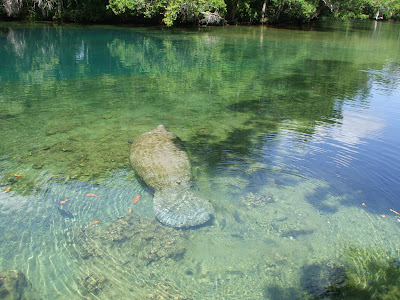
 About 300 miles down the highway we arrived at the small town of Homosassa Springs, home of an exceptional state park by the same name. Natural springs pump millions of gallons of fresh water into the “fish bowl” of the Homosassa River. The water is a constant 72 degrees which is perfect for the manatees that make it their year-round home. We visited the park and watched the manatees. They aren’t the most exciting animals to watch. Most of the time they move very very slowly and look like very large slugs or small sand bars. Many manatees outside the refuges are injured or killed by boats because they swim in shallow water and have to surface frequently for air. Some areas have very slow speed limits for boats in an effort to minimize collisions.
 The park is a wildlife refuge with its emphasis on birds. The birds include flamingos, spoonbills, blue heron, egrets, pelicans, owls and even a few bald eagles and hawks that were injured and can’t return to the wild.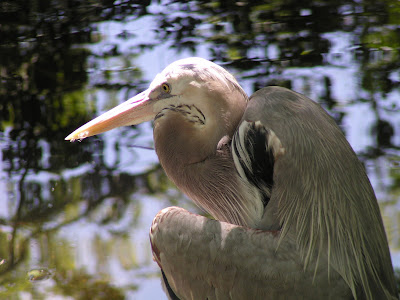
 The park also has a variety of reptiles and lots of alligators. The park naturalist showed us a baby gator. Bonnie got to touch the little feller. The big gator in the photo seemed to be “growling” at Bonnie. She caught a short video of it and we’ll try to get it to you so you can hear him growl. It sounds something like a motor boat engine.
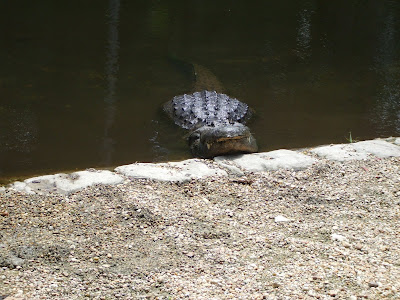 This was a very interesting park within a half mile of our RV park. It was a relatively cool shady place to go on a hot muggy day.


 We visited some of the neighborhoods that were severely damaged by the flooding following Hurricane Katrina, including the Ninth Ward where the water was deepest and about 450 people died. Nearly three years have passed since the hurricane. Most of the debris has been cleaned up, burned or hauled away, but many mutilated structures remain abandoned. In some cases, it appears that badly damaged homes are still being occupied. Many FEMA trailers are still in place, but many others are still living in tents. Habitat for Humanity and other organizations are very actively building new homes. We also saw many new single-wide manufactured homes, complete with front porches, have replaced many of the destroyed homes.
  Large flood walls protect low lying neighborhoods from the river. We saw some of the old flood walls that didn't fail. We also saw the newest walls that are giving property owners renewed confidence that it will never happen again. The photo shows one of the new walls. The remains of a destroyed neighborhood lies to the right, with new houses being built. Personally, I’d never feel safe looking up at the Mississippi River.
  Many families lost everything in the hurricane and flooding and it’s obvious that those neighborhoods will struggle for many more years. However, the central business district, French Quarter and other areas that were not damaged appear to be healthy and gaining strength.
 We drove through Bay St. Louis and Pass Christian where whole beachfront neighborhoods were wiped off the map. Scattered framework, foundations, pilings and some floors can still be seen with floor tile still attached. It’s not unusual to see a fancy iron fence and gate with a winding driveway leading to what was once the site of a large home, but is now occupied by a travel trailer.


 The Konriko Rice Mill is also in New Iberia. It's a family business and the oldest rice mill in the country. It has been operating with the same basic machinery that was installed in 1912. Still going strong with the old technology.
 We capped off our day in New Iberia with a crawfish dinner at the Seafood Connection. Locals recommended it, so it had to be good . . . and it was. The restaurant itself appeared to be an old converted 1950’s drive-in with a sit-down room addition made of cinder block with no windows or other features that might attract someone to stop there. The interior was also pretty plain, with tables lined up in rows, Bingo hall style. A big screen TV was playing a re-run of a Saturday night Cajun program up the road in Eunice, the center of Prairie Cajun. Everyone seems to be eating crawfish around here these days, so we both ordered the crawfish dinner. They came to us in big tin dishes, similar to oil change pans, with potatoes mixed in, a couple ears of corn-on-the-cob and a couple large sausages. It was a very messy hands-on dinner but fun and very tasty indeed.
 Seafood is everywhere, crawfish is king right now and there are also lots of oysters, shrimp, crab, catfish, seafood gumbo and jambalaya, andouille and boudin sausages, shrimp po-boy sandwiches and etouffees (pronounced “A-2-fay”). It’s really great!!! We'll miss the food, but will also miss the fun spirit of the local people, the music and the large swamps, bayous and unique wildlife that the state is trying hard to protect. As we head on down the road, we'll leave you with a picture of Bonnie at Bayou Teche.


 The swamp was full of birds, including herons and snowy egrets. We also came across lots of alligators. Most were sunning themselves on logs and we were able to get within a few feet of them. Some would casually slide off their logs and disappear into the water, but others stood their ground and stared us down. None were aggressive and, after a while, we began to really appreciate these big critters. They weren’t bothering anyone and were probably a little annoyed with us for trespassing in their territory. It was a great swamp tour and we all survived.


 The Anahuac Nat’l. Wildlife Refuge was nearby, so we did a walking and driving tour of a small part of the area. It’s a birder’s paradise. But, even more exciting for us, were the alligators that also reside in the refuge. We saw eight or ten gators in their natural habitat, which was one of Bonnie’s primary objectives. Pretty exciting.
 We drove to the end of the Bolivar Peninsula, ate a couple excellent burgers at Crystal Beach, visited old Fort Travis and looked at Galveston across the water. A free ferry could have taken us across but we had no reason to go there and it was getting late.

