 Massachusetts was very nice, but it was time to continue north. We drove through a small segment of coastal New Hampshire and into Maine. The further north we went, the cooler and more comfortable it became. But it was also becoming dark and cloudy and, shortly after reaching Blueberry Pond RV Park near Freeport, it began to rain . . . with a vengeance. The sky crackled with lightning and heavy thunder rattled our RV. That was just the beginning. It continued to rain off and on for the next ten days. Fortunately, the storms swept through rapidly and were interspersed with sunny periods for sightseeing and photo taking.
Freeport is the home of L.L. Bean, a primary stop for tourists passing through. It's an interesting store with lots of unusual features, such as the "hunting lodge" lounge in the photo below. Bean has grown into a complex of stores that includes an “outlet” store with very reasonable prices. Freeport has many other upscale outlet stores. It's a fun place to browse.
 After a couple days in Freeport, we continued north and set up camp in Ellsworth, about 30 miles from Bangor and 15 miles from Bar Harbor and Acadia National Park. Mother Nature greeted us with one of the most violent thunder storms we have ever experienced. Buckets of rain fell while very loud crackling thunder shook the motor home. It felt like the sky was being ripped apart. Amazing.
After the storm drifted off to the east, we took a leisurely drive along Frenchman Bay to the village of Winter Harbor. From there, a shuttle bus took us through a remote portion of Acadia Nat’l. Park. It’s a bit difficult to get to, so it’s not crowded at all, as you can see in the photos. We had a good time playing on the massive rocks and watching the waves and sea birds.


 We reserved the best sunny day for a trip to Bar Harbor. It’s a serious tourist destination and traffic is intense but not impossible. We arrived early and found a spot in a public parking lot near downtown. We got carried away and stayed about seven hours in our three-hour parking spot. Fortunately, we didn’t get a ticket.

 Bonnie likes to be out on the water so a boat ride was a priority. Lots of boat tours were available. We had trouble deciding whether to go on a whale watching boat, a ferry to the Cranberry Islands, a lobster boat, a sailboat, etc. We finally decided to join Captain Ed for a sail around Frenchman Bay on his lobster sloop “Chrissy” (photo). A nice breeze was blowing and it was a perfect day for a relaxing sail on the bay.
Ed told us the history of his 1910 sloop and all about the local lobster industry. He had several lobster traps in the bay and stopped to check them. He caught one but it was a little fella and had to be tossed back.

 The Royal Carribean cruise ship Explorer of the Seas was in port with its 3,100 passengers. They clogged the sidewalks, stores and restaurants and pumped a good amount of revenue into the local economy.
 We spent parts of three days exploring Acadia Park. It’s a beautiful park with miles of rocky shoreline, vistas, wildlife, historic carriage roads and hiking trails. We climbed on more rocks and poked around the bookstore and lighthouse at Bass Harbor.
 Jordan Pond is a very popular and scenic place. We found a patch of wild blueberries and were merrily picking when the sky opened up again and gave us a brief shower.
 The highlight of Acadia Park was viewing Bar Harbor and the Maine coastline from the top of Cadillac Mountain. The mountain rises to a nosebleed elevation of 1,530 ft. That’s not very high by Northwest standards, but it’s the highest point along the entire east coast of North America. A roadway leads to a parking lot near the rocky top and we managed to struggle the final 100 feet or so to the summit (without oxygen). From the top, visitors can admire views in all directions from a series of easy trails and viewpoints.

 Lobster (lobstah) is king in Maine. There are “lobster pounds” everywhere. These are places where one can buy fresh live lobsters to take home, or have one cooked on the spot for instant consumption. Luckily for us, the price of lobster is down this summer. Some places are selling lobster rolls and meals for around $12. We ate our share of seafood, including lobster, shrimp, crab rolls, fish & chips, bacon-wrapped scallops, fish and corn chowder and other local delicacies. On August 6 we celebrated Bonnie’s birthday with a non-seafood dinner of prime rib and pork. It was a nice change of pace.
 Maine is a very nice quiet place. The people are nice and friendly and life seems to be a little more laid back. We love the rocky coastline and thick woods. The small towns with their old buildings are very picturesque and nearly all the towns have white church steeples poking up above the trees. Families live in houses built in the early 1800s and kids still attend 100 year old brick school houses. Things move a little more slowly here in Maine. It's a very nice change of pace.
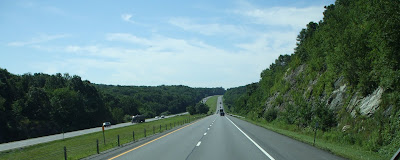

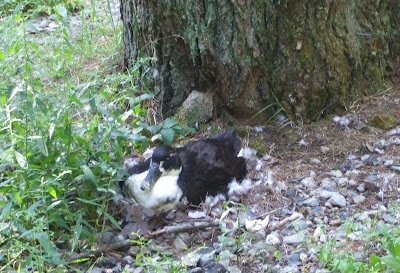 We targeted four places during our stay in Massachusetts; Hyannisport, Fall River, Newport and Plymouth. Each was different and interesting in its own way.
 After a quick burger at Mr. Dude’s, we caught a harbor cruise on the Prudence that took us out into the ocean to view sailboats, coastal homes and the Kennedy compound.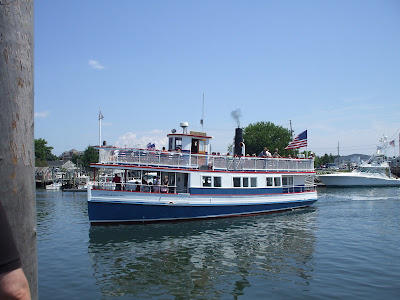
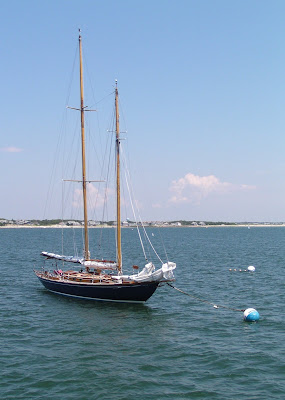
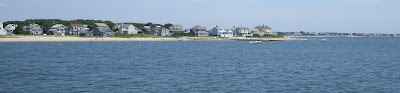 Around the corner and along a stretch of nice beach was a line of big beach homes, including the Kennedy compound. The main Kennedy house is the large white one with the multiple gables. That's where Senator Ted lives. The next photo is Ted's sailboat. According to the tour guide, he sails often.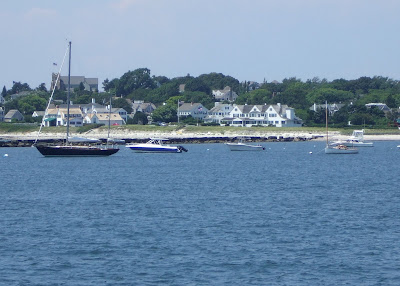
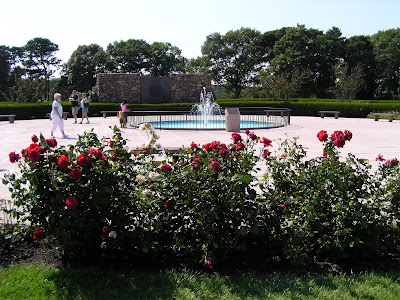
 After the tour we drove down the beach to Kennedy Memorial Park. It's a very nice little park with a bronze memorial plaque on the rock wall behind the fountain and lots of rose bushes and other gardens overlooking the ocean.
 We also snooped around the neighborhood to see how close we could get to the Kennedy compound. There were no high walls or gates and we got within a block or so before encountering discouraging signs. The Senator wasn’t home anyway, so we didn’t stop to chat.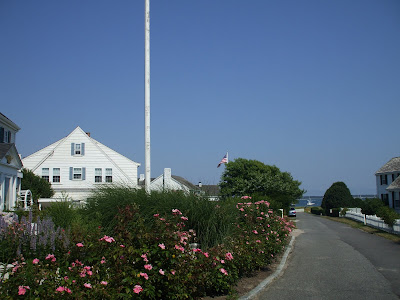

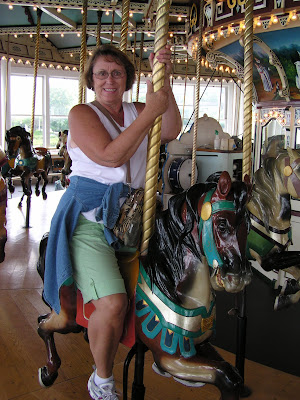

 Outside the main house is a children’s playhouse (below) with all the details of a full-scale house, and some extras. Note the carved porch posts. There was also a separate house for the manager who managed the household and all the cooks, maids, groundskeepers and other servants that kept the place going.
  We also toured Marble House, which was built for Alva Vanderbilt, a local society hostess and a leader in the women’s suffrage movement. Her husband William Vanderbilt gave her the house as a birthday gift. She divorced him three years later and married another Newport millionaire. This house was built primarily of marble in all colors. Much of it was brought by ship from Europe and cut and shaped by Italian workers on the site. The house is hard and cold but is lavishly decorated and very impressive inside and out. It cost $11 million to build in 1892. Imagine what it would cost in today’s dollars. Again, photos weren't allowed inside, but the house is incredible. Bonnie bought a book describing all the great mansions of Newport.
 Plymouth: A couple months ago we were in St. Augustine, America’s oldest continuous community. As a follow-up, we had to visit Plymouth to see where the Pilgrims landed in 1620. Plymouth is very attractive with some of the oldest buildings in the country and its harbor full of boats. It's a very pleasant and comfortable community to visit.
 The Mayflower II, a replica of the original ship, is moored at a pier a block from the Plymouth Rock monument. It was actually sailed across the Atlantic in the 1950s and is now a tourist attraction.


 We chose the Black Bear RV Park because a guy named Al runs a van tour of New York right from the campground. His all-day tour began at 8:00 am. Al provided a non-stop flow of factual information and interesting stories about the city as he drove us down the New Jersey Turnpike, past the Giants stadium in The Meadowlands, past Sinatra’s home town of Hoboken and to Liberty State Park and the ferry terminal for a boat ride to Ellis Island and the Statue of Liberty. Along the way he pointed out huge mounds of new industrial lands that were once “worthless wetlands” but, after years of channel dredging and sanitary landfilling, are now productive industrial lands. (Not wanting to ruin the tour, we withheld our comments.)
 Ellis Island was one of the most interesting places we visited. The immigration station on the island opened in 1892 and processed about 12 million immigrants who came to America looking for new opportunities and better lives. This process only lasted until the 1920s when most of the operation was transferred to the U.S. consulates.
 The old buildings deteriorated until the 1980s when the main building was restored and opened as a museum telling the immigration story. It now contains lots of old photos and documents and it’s a very fascinating place to visit, especially for those who had an ancestor enter the country through Ellis Island.
 Al drove us through the Holland Tunnel and into the heart of Manhattan. Our first stop was “Ground Zero”, the site of the former twin towers of the World Trade Center. We walked around the area and looked through the heavy steel fence into the massive pit. It was hard to find a good picture angle, but you can see that the rubble is gone and the new “Freedom Tower” is under construction. When finished around 2011, the tower will reach a height of 1,776 feet. The Empire State Building is about 1,250 feet high.
 St. Paul’s Chapel dates back to the 1700s. George Washington attended church there. His pew and personal chair are still there to see. The chapel is near the Ground Zero site and was one of the most important staging areas during the 9/11 tragedy. Today, it has memorials to those who lost their lives.
 The final piece of steel salvaged from the twin towers was in the shape of a cross and has been placed near the chapel as another memorial. Several other wall sculptures and murals adorn nearby buildings. The Sept. 11, 2001 event made an impact on New York City that will never be forgotten.
  Al drove us all around Manhattan, through the financial district, up the East River, past the Brooklyn Bridge, along the west side of Central Park, and past the Empire State Building, Trump Towers and other interesting sites.

 We were advised not to drive downtown. It was good advice. Al gave us a white-knuckle ride that left us impressed with his ability to weave his van through heavy traffic and wedge it into the tightest places, inches from other vehicles, pedestrians, utility poles, etc. New York drivers are very assertive and not at all polite. They have no respect for bicycles or pedestrians. In turn, cyclists weave in and out of traffic and pedestrians J-walk everywhere. Many of the downtown streets are one lane with parking on both sides. It’s very congested. Driving in the Big Apple requires a different set of skills. It’s not for the timid. Al does it every day.

 We left Manhattan around 5:00 pm. We didn’t think we’d ever get out of town during rush hour. But, once we got out of downtown, it was an uneventful ride back to the campground. Freeways flowed smoothly and Al put on a Joni James cassette tape for our listening enjoyment. Just before arriving at the campground, he played Frank Sinatra’s classic “New York, New York”. It was the perfect ending to a full and interesting day. Our one-day tour barely scratched the surface of New York, but gave us a quick overview. Maybe we'll return some day and take in a Broadway show or a game at the new Yankee Stadium. In the meantime, we're happy to continue into New England in search of a good lobster dinner.